Monday, February 3, 2014

From my desktop, two spreads from "The Bell on the Knoll," a history of the Christ School Chapel


A wonderful opportunity to access and pluck stories and images from extraordinary archives and fashion a history that will inevitably touch the hearts of alumni and many others who have loved, and still love, this highly significant place ~ so deeply influenced by its chapel.


It's been a great pleasure working with partner (and old friend) Linda Cluxton on the evolution of this book from a design perspective.  Many thanks to Dabney Johnson for her passionate and inspired research into all manner of names and events and to Father Kirk Brown for his collaboration and support, as well as Headmaster Paul Krieger and others at the school. 
"The Bell on the Knoll," 40 pages in length, will publish in the early spring of this year.


Thursday, August 22, 2013

A new book about a "grand dame" children's home, at its one hundredth anniversary


Many thanks to Director Jim Swinkola, the staff and board of Grandfather Home for Children for  the chance to step off into this literary and design adventure covering a century of care for  


children in need.  Ann Baker, my design partner, and I are thrilled to bring this story new life and energy and hugely grateful to  Dudley Gilmer, whose book "The Child Before Us" informed so   


much of the narrative and visual approach.  We were fortunate to have a deep collection of archival photographs to work with, organized and made accessible by Mae Weed on Grandfather's 


staff.  All told, the book is organized into 20 chapters (68 pages) and will publish in mid-September of this year.  It's particularly gratifying to have a second book about a High Country institution making a tremendous difference in the lives of children published in the same year.

Saturday, November 24, 2012

"Shared Miracles," a new book about the 90-year partnership of the DAR and Crossnore School.

This is a book about history, a 40-page e-book, that stems from a meeting I had with Dr. Phyllis Crain, head of The Crossnore School late in 2011. She very much wanted to pay tribute to the Daughters of the American Revolution, an organization whose support for the school began in the twenties and continues today. A year in the making, the book traces key events, gifts and sea changes via a richly illustrated story, a kind of American heritage piece with spreads as theatrical as designer and friend Ann Baker and I could make them. I hold tremendous gratitude for the opportunity that Phyllis Crain gave me to craft this history and I am especially pleased it is being published after her death in July, 2012, from a long, long battle with cancer. Many thanks to Ann and to the Crossnore and DAR communities for helping make this book such a pleasure to craft. Copies will be available, beginning in December 2012, through Blurb books.

Tuesday, June 12, 2012

Thirty years ago, when Asheville teetered on the edge of Paris.

It may have been leaning in that direction but it took vision and planning to materialize the city's far-reaching renaissance of art and culture. This remembrance focuses on one part of that larger inspiration. June, 2012, The Laurel of Asheville.

Monday, February 20, 2012

For The Laurel Magazine, a short piece about a small revival in a Swannanoa neighborhood

The house on the hill is not THAT old, after all, built in 1976 when its current owner moved in.

Even so, 35 Appalachian winters can take a serious toll and, for Mrs. K., who didn’t want to move from the place that’s been home for so very long, the future was looking grim.

“Rack and ruin is more like it,” she says.


That’s her description of life around the next bend if Mountain Housing Opportunities hadn’t responded to her call and brought her into its Rural Home Rehabilitation program.

Beginning in the latter part of November and well into February of this year, “rack and ruin” has shifted to “rehab and revive.” In that time frame, experienced contractors have restored plumbing, re-graded her yard, put up a deck with hand rails, insulated crawl spaces, caulked windows, re-aligned gutters and replaced roofing, updated fixtures and baths, painted walls, installed siding and generally brought the entire home up to federal housing standards.

“I’m excited,” she says. “My house was the best Christmas present I could have had. But then, I’m trying not to get too excited. Not until everything is finished!”

When Mrs. K. (who prefers not to use her full name) first applied for assistance, living alone and disabled and with a freakishly high water bill, she had reached a point of desperation.

“I was taking care of my mom and the house stuff was overwhelming,” she remembers. “What would I ever do to fix this?”

Following her mom’s death, she networked her way into a connection with Mountain Housing Opportunities (MHO)--making an initial phone call to “211.” Through its Emergency Home Repair program, the agency immediately tackled her plumbing line breaks. Then she applied for structural repairs, working with Mike Lauff, MHO’s rehab specialist, in a program developed for Buncombe County called Rural Home Rehabilitation.

“Funding for rehabs takes place in cycles,” Mike Lauff reports. “To get an authorization, we have to get down the whole world of everything that needs doing, including all the pieces and parts of things that need to be replaced. It can be pages and pages of lists. Then we put the project out for public bids, which can be extremely competitive.”

Underwriting flows from Community Development Block Grant funds distributed by the NC Department of Community Assistance. Since 1991, when the Rural Home Rehabilitation program went to bat for low-income families, there have been more than 138 structural rehabilitations in rural Buncombe County administered by MHO.

“This is taxpayer money,” says Mike Lauff. “So there’s a ton of due diligence involved. What’s cool is the dollars are re-invested right back into the community where the work happens. It goes to a very useful purpose.”

“Useful” would be a major league understatement for Mrs. K.

“I had to wait a long time,” she says, “but I’d sure do it again. With all they’ve done around here, all the energy savings, I’m not planning to go anywhere. I love my house.”

Encapsulating the 100-year life and legacy of a revered boarding school in dimensional panels


Many, many thanks to Phyllis Crain, Rachel Deal, Kathy Dellinger, Ann Baker, Howard Covington, Rachel Hoilman, Bobby Crenshaw, the Historical Museum of Avery County, and so many others who have chipped in ideas and helped us find the actual objects that distinguish this exhibit for The Crossnore School. Each panel (shown is the second in the series) focuses on a roughly twenty year period within the linear history, ending with the first student production in the new Hayes Fine Arts Building. We're honoring a centennial: 100 years of offering a safe place for children to learn, grow and move beyond remarkably hard and generally abusive circumstances. Connie Aridas: Design.

Living lightly

Thanks to Sarah Davis of Biltmore Farms for the opportunity to collaborate. Connie Aridas, design.

Saturday, July 2, 2011

After nearly a hundred years of serving children, an opportunity to weave, in fresh colors, the story of the Crossnore School.

Two booklets: one aimed at parents and educational consultants, the other at individuals who can change the trajectory of a child's life by offering scholarship funds for a girl or boy in need. The Crossnore School began in 1913, primarily as a result of Eustace and Mary Martin Sloop, both doctors, taking a dedicated interest in mountain children bettering their lives through education. Marching through bouts with moonshiners, wars, depressions, floods, fires and myriad tragedies, the school has persevered to become one of the finest of its kind, a resilient beacon of hope and healing. Writer/art director: Jay Fields/Connie Aridas. Inspiration: Dr. Phyllis Crain, executive director.

Wednesday, June 15, 2011

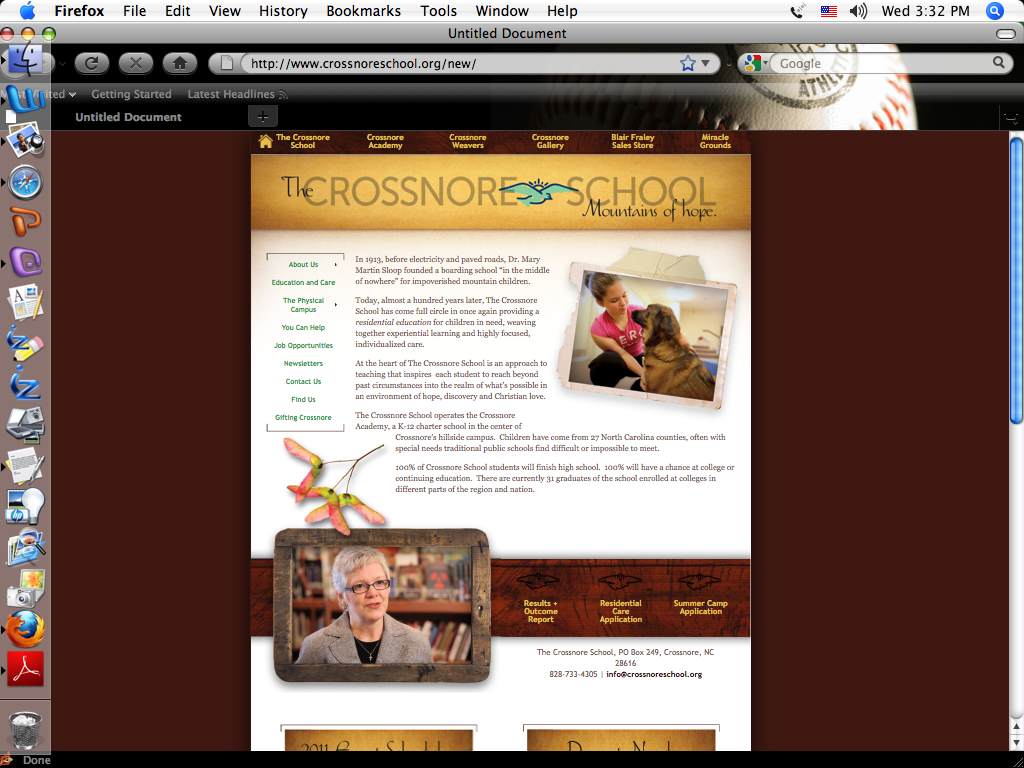
A site for the Crossnore School.


An in-progress glimpse at a refreshed web site for the school with completion set for mid-August. Many thanks for the enthusiastic support of Executive Director Phyllis Crain, Melynda Pepple's ongoing resourcefulness (especially with photography, past and present), and the affirming helpfulness of everyone on campus. Shown here: the home page template. It's been, and continues to be, a tremendous honor to work with a school with so much compassion at its heart. Page design: Connie Aridas. Mapping and coding and web work: Heidi Lusk.

A sweeping resource for caregivers.


This not-for-profit foundation, called "APPEL" (or Avery Partnership for People at the End of Life), weaves a support system for caregivers, including grants for hospice care when other means of support aren't available. Part of its mission, too, is helping the caregiving community with spot-on information about services that can help medically, financially, legally and spiritually. This web site encompasses those resources and sets up a platform for sharing stories and ideas within a community that is often overwhelmed with too many duties and too little time.

We interviewed leaders in key caregiver organizations, helped structure the site, wrote and gathered the content. Partner Connie Aridas, working with board member Ann Baker, shaped the logo, based on an Avery County apple tree, and designed the site's templates which she handed off to web master Steffi Rausch. I am grateful to Ann, to Coy Franklin and to all the members of the APPEL board for pitching in and making this project sing with good information. As a WordPress site, content management will shift to the APPEL team with the launch of appelnetwork.org.

Wednesday, March 16, 2011

Studio portrait of a Kenilworth neighbor.


Colin Richmond, fashioner of over 60 breeds of porcelain sheep, plus an occasional lion, llama, donkey, alpaca, Highland Coo and Belted Galloway.

The swimming pool as sustainable architecture.

A creative assignment from Mark Bastin of JDM Strategies: How do we tell parallel stories of graceful design, detailed engineering and sustainability? Here's the result--a journalistic-style ad for a magazine read by homeowners and architects. Jay Fields, writer; Michael Ashmore, art director.

Saturday, March 5, 2011

An economic development folder for the geologically ripped little town of Chimney Rock.

It's a joy to write about a place I've often visited and always loved. At one time or another, I've watched my daughters rock-jumping the Rocky Broad and painted the river across a large canvas where I threw down watercolors in great splashes of color. I like the opening to this lovely piece, worked out by Bryan Hughes, following Sharon Harms' original design template: No bigger than a minute, the town of Chimney Rock nevertheless presides over a timeless scene--of falling water, sheer rock face and evergreen forest. Even the names of its neighboring towns—Bat Cave and Lake Lure—suggest the inherent fairy tale quality of this place, a gravitational draw for naturalists and sightseers for well over a century.

An enjoyable project for friends at HandMade and in Chimney Rock.

Monday, February 21, 2011

Tuesday, February 15, 2011

An ad for this historic school's first summer day camp.

Many thanks to Phyllis Crain, executive director for the school, and to Connie Aridas, my design partner.

Sunday, December 26, 2010

A good year


Rounded out with an art show in my Kenilworth neighborhood. Small sketches.

Mail series for a bank's female clientele


One of a string of mailers--this one falling at Thanksgiving--that reminds women customers that Carolina Alliance Bank holds them in "high consciousness" and wants, sincerely, to maintain both rapport and dialogue. Thanks to partner Connie Aridas for bringing me into this ongoing project.

Saturday, December 25, 2010

A new site for a Knoxville fulfillment house that, among other things, handled over a hundred million sweepstakes entries this year alone.

I appreciate the chance to work with Mark Bastin of JDM Strategies (Asheville) and Wade Ewers, president of Ritway (Knoxville). It's a rare opportunity to work on a site this complex (about 40 main sections) and with a group of people of such genuine integrity, good spirit and warmth.

The Crossnore School: Weaving a tale of lives changed and miracles in the offing.

A wonderful opportunity to re-position this historical and profoundly successful place as both an esteemed boarding school and a healing, caring environment for children in need. I am in deep gratitude to Dr. Phyllis Crain for the amazing chance to tell this story well and my very aware, very conscious partner, Connie Aridas, who brings a sensitive hand to the design of pieces aimed at donors and stakeholders as well as parents and educational consultants.

An illustrated history of HandMade in America's artfully collaborative Small Town Program

A composite of 15 years of impassioned work, often triggered and inspired by HandMade leadership, brought to life by countless volunteers in some of Western North Carolina's smallest places. An essay (falling across twenty pages) that practically unfolds on its own because of the tremendous energy and devotion of participants, many of whom I interviewed over a two-month period to form the nucleus of this textured story. Connie Aridas orchestrated the design, as she said, "keeping the flavor of small towns" visually throughout, and Judi Jetson at HandMade provided the initiative and support. Many thanks to everyone who read this piece, spoke with me in person or by phone, and helped render a process and a history that I believe can and will be helpful to small towns basically anywhere in the world.